

Head Wraps for Work: A Guide to Head Coverings in the Workplace


What's In This Article
Can you wear a head wrap to work? Yes. In the UK you can wear a head wrap, headscarf or turban to work in almost every job, and in most cases your employer cannot stop you. Whether you cover your head for medical, religious, cultural or purely personal reasons, a well-chosen head covering is as professional as any other part of your outfit.
We’ve been fitting headwear for women and men with hair loss since 2007, from our shop in Slaithwaite, Huddersfield. A huge number of the customers we speak to are working: nurses, teachers, solicitors, warehouse staff, care workers, shop managers, people on Zoom all day. The questions they ask are always the same. Will it look professional? What are my rights? Will I be too hot? What do I say when someone asks?
This guide answers all of them. It’s written for anyone considering a head covering at work, for any reason, and it covers women and men.
The Short Answer
Head wraps are appropriate for work. The only situations where you’ll need to adapt are jobs with genuine safety or hygiene rules (food preparation, some factory floors, clinical settings), and even then the answer is usually a different fabric or a hair net over the top, not going without.
If you want a head wrap to read as professional, follow the same rules as the rest of your clothes: a fit that looks deliberate, colours and fabrics that suit the setting, and no loose ends. A structured turban in navy or charcoal is as smart as a blazer. A soft bamboo wrap in a muted print works in most offices. Save the sequins for Friday night.
Your Rights: Head Coverings and UK Employment Law
A little note from us: We know wigs and headwear, but we’re not legal experts. The information below is intended as a helpful starting point. If you have questions about your own circumstances or workplace, Acas or Citizens Advice can provide advice specific to your situation.
| Your situation | What you should know | Helpful links |
|---|---|---|
| Religious head coverings | Religion or belief is protected under the Equality Act 2010. Workplace dress codes should be flexible enough to accommodate religious needs, although an employer may be able to justify restrictions where there is a legitimate reason, such as health, safety or hygiene. | Acas: Religion or belief at work |
| Sikh turbans | Turban-wearing Sikhs have a specific exemption from legal requirements to wear safety helmets in most UK workplaces. There are limited exceptions for certain hazardous emergency-response and military situations. | HSE: Sikh head protection exemption |
| Head coverings during cancer treatment | Cancer is automatically treated as a disability under the Equality Act 2010 from the point of diagnosis. Employers have a duty to make reasonable adjustments where required, which may include considering changes to workplace dress requirements. | GOV.UK: Disability and the Equality Act |
| Head coverings for alopecia | Alopecia is not automatically classed as a disability. It may meet the Equality Act definition if its effects are substantial and long term and affect normal day-to-day activities. The individual circumstances matter. | Alopecia UK: Support and information |
| Cultural or personal head wraps | The legal position will depend on why the covering is worn and how the employer’s dress code is applied. Workplace rules should not discriminate against employees because of a protected characteristic. | Acas: Dress codes at work |
| Safety, hygiene and uniform requirements | Employers can have legitimate dress requirements for reasons such as food hygiene, infection control or machinery safety. This may affect the type of head covering that can safely be worn rather than necessarily preventing a head covering altogether. | HSE: Workplace health and safety |
Speaking to your employer
If you’re worried about wearing a head covering at work, a short conversation with your manager or HR team can often help clear things up.
You could simply ask:
“I’ll be wearing a head covering at work. Is there anything in the dress code I should know about?” – You don’t necessarily need to explain your full medical history just to start that conversation. If your head covering relates to a disability and you need an adjustment at work, however, your employer may need enough information to understand what support or adjustment is required.
If you’re unsure about your rights, Acas or Citizens Advice can give you further guidance based on your individual circumstances.
Who Wears Head Wraps, and Why
People choose to wear head wraps for all sorts of reasons. For some, it’s about comfort during hair loss. For others, it’s part of their faith or culture, a practical way to look after their hair, or simply a style they enjoy wearing. You may see head wraps worn by:
- People experiencing hair loss. This might be due to chemotherapy, alopecia, trichotillomania or another type of hair loss. Some of our customers alternate between wigs and headwear, while others feel happiest wearing a wrap every day. There really isn’t a right or wrong choice.
- People who cover their hair as part of their faith. Head coverings are worn within a number of religions and traditions, including Islam, Sikhism, Judaism and some Christian communities. The style and meaning of the covering can vary considerably from person to person.
- People for whom head wrapping has a cultural significance. Head wraps have a long history in many cultures, including across Africa and the Caribbean, and can be worn for cultural, practical and personal reasons.
- People looking for something soft and comfortable. If your scalp is particularly sensitive, a carefully chosen head covering can sometimes feel more comfortable than leaving the scalp uncovered or wearing a wig for long periods.
- And people who simply enjoy wearing them. Sometimes there doesn’t need to be a bigger reason. A head wrap can simply be part of your outfit and how you choose to wear your hair, including on a wet Monday morning.
We see this variety amongst our own customers too. Kristi told us that after taking part in an alopecia areata clinical trial, her hair returned very different to how it had been before. She found wearing wigs at work too warm and initially felt nervous about changing to scarves. When she eventually did, she described the experience as feeling like freedom.
Another customer, Johnnie, wears head wraps to work every day and contacted us looking for more styles to choose from. You can read both of their experiences in the comments below.
What Makes a Head Covering Look Professional
“Professional” isn’t a fabric or a colour. It’s a set of signals. These are the ones that matter most for headwear, based on years of watching what our customers wear to interviews, courtrooms, wards and boardrooms.
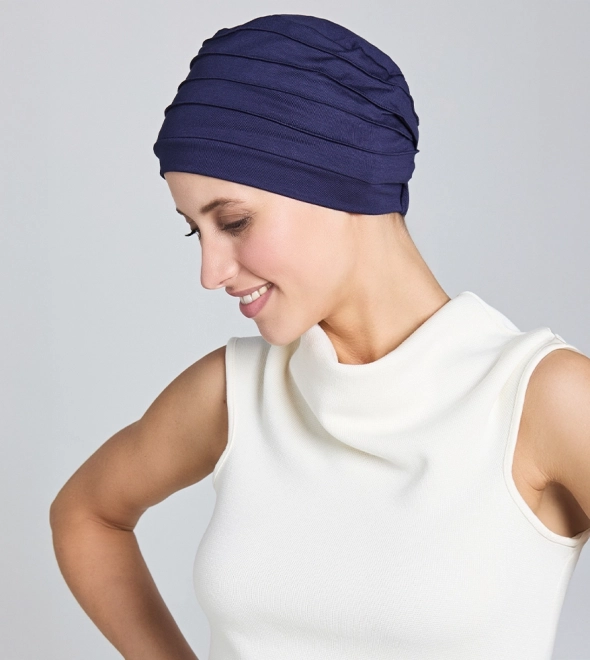
- Intentional fit. A wrap that sits evenly, covers the hairline neatly and doesn’t slip reads as deliberate. One that’s twisted, gaping or constantly readjusted reads as an afterthought. Pre-tied turbans and structured wraps make this easy.
- Fabric that matches the setting. Matte cotton, bamboo, jersey and fine wool look considered. Shiny satin and heavy sequins skew to eveningwear. Linen looks lovely but creases.
- Colour that works with your wardrobe. Navy, charcoal, black, camel, forest green, burgundy and cream go with almost everything. If you love pattern, choose a small, tonal print for weekdays.
- No loose ends at desk height. Long tails look elegant in photos and get caught in lanyards, headsets and filing drawers. For work, tuck or knot them.
- Consistency. People adjust to anything they see regularly. If you wear a head covering on day one, by day five it’s simply part of how you look.
What doesn’t matter: whether your colleagues can tell you have hair underneath. Almost nobody thinks about it, and those who do will assume it’s a style choice.
Choosing a Head Wrap for Your Job
| Your workplace | What to look for | Watch out for |
|---|---|---|
| Office, professional services, meetings | Structured turban or fitted wrap in a neutral or muted tone; cotton or bamboo | Anything that competes with a suit; very casual jersey beanies |
| Video calls, remote work | Solid mid-tone colours (navy, teal, plum) that read well on camera; avoid busy prints and pure white | Fabrics that shine under ring lights |
| Teaching, childcare | Comfortable, secure, washable; a bit of colour is a plus | Long tails children can pull |
| Healthcare, care work | Close-fitting, breathable, washable at 60°C; check your trust’s uniform policy | Loose fabric near patients; some trusts ask for hair fully covered |
| Retail, hospitality front-of-house | Smart, coordinated with the uniform; ask whether a branded cap can go over the top | Prints that clash with uniform colours |
| Kitchens, food production | Full coverage under a hair net or in a cook’s-hat style; cotton, no dangling ends | Fabrics that shed; anything not fully enclosed |
| Warehouse, workshops, labs | Fitted, nothing loose; check PPE compatibility (hard hats, goggles, ear defenders) | Ties and tails near machinery |
| Outdoors | Layered for weather; UPF fabric in summer; warm knit in winter | Watch out for: Choosing a fabric that’s too warm in summer or not warm enough in winter. |
If you wear a headset, choose a slimmer wrap at the ears or a turban with a lower profile at the sides; the Christine Headwear styles tend to be flatter than volumised turbans. If you wear glasses, make sure the wrap doesn’t sit on the arms. If you have a lanyard, keep tails short.
Head Wrap Styles for Work
These are the shapes we’d point you to for the working week. All are from our headwear for hair loss range unless noted, and every one is designed to be comfortable on a bare or sensitive scalp.
The pre-tied turban. The workhorse. Pull on, adjust, done. Structured enough to look tailored, soft enough for eight hours. Our understated Becca turban by Christine Headwear is the one we recommend most for offices. Browse all turbans for hair loss.
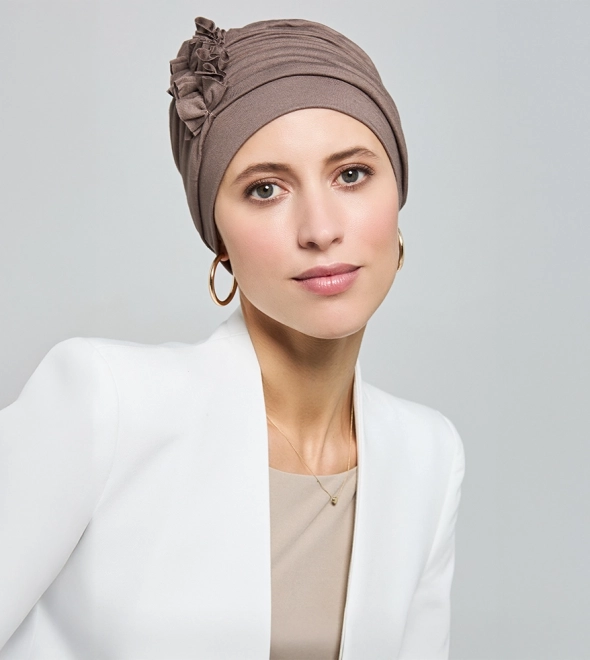
The knotted-front turban. A single twist or knot at the front adds interest without adding fuss. The Zoya V turban does this well and comes in muted tones.
The fitted cap or beanie in soft bamboo. For workplaces where a turban feels too dressed, or under a uniform cap. Minimal, breathable, and the fabric wicks moisture. Good for healthcare.
The wrapped scarf. A square or rectangular scarf tied into a low knot at the nape or a side twist. The most flexible option and the most fabric-dependent; choose a matte cotton or a fine wool. Browse scarves for hair loss.
The wrap with a fringe or hair piece. If you’d like the look of hair at the front, a fringe hairpiece clipped under the front edge of the wrap gives a natural framing effect and reads as your own hair under a stylish scarf. See our fringe hairpieces.
A brighter option for less formal days. A sunflower-yellow or coral turban is perfectly appropriate in creative, care, education and retail settings. Colour is not unprofessional; mismatch is.
If you’d like help choosing, book a free appointment and we’ll go through options for your specific job. Bring your uniform if you have one.
Professional Head Coverings for Men
Men cover their heads at work too, and they ask us about it more than you might expect.
Religious coverings. A Sikh dastar, a kippah, a kufi or a taqiyah are all recognised religious dress and protected under the Equality Act. Employers should accommodate them, and as noted above, Sikh men have statutory protection around safety helmets.
Medical hair loss. Men going through chemotherapy, or with alopecia totalis, often find a shaved or bare head cold in the office and uncomfortable in the sun. The smart options are a fine knitted beanie in a dark neutral, a fitted cotton cap, or a soft bamboo sleep cap for indoors. Avoid sports-branded caps unless your workplace is casual. Many of the caps in our headwear range are unisex; the plain, dark styles work well for men.
Style. A flat cap or a fedora worn to and from work is a personal choice. Indoors, most UK offices still read a hat on a man as casual unless it’s religious or medical, so if you’re wearing one for comfort, a low-profile beanie or fitted cap is the safer reading.
For men considering a wig instead, our men’s wigs range and our article on male wig wearers are the place to start.
Headbands, Bandanas and Beanies: Where's the Line?
These are the questions we get asked alongside head wraps, and the honest answers.
Are headbands professional? Yes, if they’re slim, in a neutral or tonal colour, and made of a structured fabric or fine knit. A padded velvet or satin headband is now standard smart-office wear. What reads as unprofessional is anything sporty (terry towelling, elastic athletic bands), novelty (ears, bows over a certain size) or very shiny.
Can I wear a headband to an interview? Yes. A slim, plain headband in a colour that matches your outfit is fine for any interview. It can also be a useful, discreet way to hold a wig’s hairline or cover thinning at the front without a full wrap. Avoid anything wide enough to be the first thing the interviewer notices.
Can I wear a bandana to work? It depends heavily on the workplace. In kitchens and some trades, a bandana or cotton head covering is standard and sometimes required. In offices and client-facing roles, bandanas read as casual and are best avoided unless your dress code is relaxed. If you like the shape, a bandana-style tie in a matte, solid-colour fabric from a headwear range looks noticeably smarter than a printed cotton square.
Beanies? Fine in casual and outdoor workplaces, and in most offices if they’re fine-knit, dark and worn for a medical reason. Chunky or slouchy knits read as outerwear.
Can I Wear a Head Wrap to an Interview?
Yes, and it should not affect how you’re assessed. If you’d wear a head covering in the job, wear it to the interview; it lets you be yourself from the start and removes any question of a “reveal” later.
A few practical tips from customers who’ve done it:
- Choose your most understated option – for the interview itself. Save the print you love for week two.
- Try the whole outfit on together – a day before, including the head covering, and check it in daylight and on camera if the interview is remote.
- Don’t feel you have to explain – Don’t feel that you have to explain why you wear your head covering. If you’d like to mention it, a simple sentence is enough: “I wear a head covering and I’m happy to talk about any dress code or practical requirements for the role.
- If the role involves uniform or PPE – it’s reasonable to ask how head coverings are accommodated. This shows you’re thinking about the job, not the wrap.
One of our community members wrote about her experience of starting a new job with alopecia, and it’s worth reading before an interview.
Comfort for a Full Working Day
The difference between a head wrap you love and one you abandon by lunchtime is almost always comfort. A few things we’ve learned.
- Fabric first: Bamboo viscose is one of the fabrics our customers often choose for long periods of wear soft, breathable, wicks moisture and doesn’t itch on a sensitive or freshly shaved scalp. Cotton jersey is a close second. Polyester traps heat.
- Fit, not tightness: A wrap should stay put through a day of nodding, turning and headsets without pressure. If you get a headache, it’s too tight. Pre-tied turbans with a soft inner band solve this.
- Manage heat: If you overheat in wigs at work (a very common complaint), headwear is genuinely cooler. In summer, lighter fabrics and a slightly looser wrap; in winter, a fine liner or a knitted style.
- Protect the scalp: If your scalp is bare or sensitive, a soft wig liner or cap under the wrap adds a comfort layer and helps the wrap grip.
- Have a spare: Keep a second wrap in your desk or bag. Coffee happens.
- Wash regularly: Most bamboo and cotton headwear washes at 30 to 40°C and dries overnight. Our guide to caring for headwear has the detail.
How to Wear a Head Scarf: Three Quick Styles
If you’d rather tie your own than buy pre-tied, these three take under two minutes each and all sit neatly for work. Our ultimate guide to headwear for hair loss has more styles and video.
The low nape knot. Fold a square scarf into a triangle. Place the long edge along your forehead, take the two side points behind your head and tie them over the third point at the nape. Tuck the ends under. Neat, secure, and works with headsets.
The side twist. Start as above, but bring both side points to one side above the ear, twist them together, wrap the twist around itself into a rosette and tuck the ends. Adds shape without height.
The front knot turban. With a rectangular scarf, centre it on the back of your head, bring both ends to the front, cross them, twist once, take them back and tie at the nape, tucking the ends. This gives a turban silhouette from a flat scarf.
For all three, a thin liner underneath stops slipping and keeps the fabric off your skin.
Handling Questions and Comments
Most people will say nothing, or say something kind. A few will ask. Here’s what our customers find works.
- “Is that for religious reasons?” “No, it’s for medical reasons” or “No, I just like it” are both complete answers. You don’t need to add anything.
- “Did you lose your hair?” You can answer honestly if you want to, or deflect: “It’s a long story, but I’m doing fine, thanks for asking.”
- “Can I see your hair?” “I’d rather not, but I’m happy to show you my collection of turbans” usually ends it warmly.
- Persistent or intrusive questions are a workplace conduct issue, not something you have to manage alone. Speak to your manager or HR.
Our article on what to say when someone asks if you’re wearing a wig covers the same ground for wig wearers and the scripts transfer well.
Frequently Asked Questions About Wearing Head Wraps at Work
People choose to wear head wraps for all sorts of reasons. For some, it’s about comfort during hair loss. For others, it’s part of their faith or culture, a practical way to look after their hair, or simply a style they enjoy wearing.
- Can I wear a head scarf to work in the UK?
-
Yes, in most workplaces. Employers can have dress, safety, hygiene or uniform requirements, but these should be applied fairly. Religious dress may be protected under the Equality Act, and if a health condition meets the definition of disability, an employer may also have a duty to consider reasonable adjustments.
- Are head wraps professional?
-
Yes, when chosen with the same care as the rest of your outfit: a deliberate fit, a fabric and colour that suit the setting, and no loose ends. Structured turbans in neutral tones are as smart as any other professional accessory.
- Can an employer ban head scarves in the UK?
-
Only with a genuine and proportionate business or safety reason, and a blanket ban on religious head coverings could amount to discrimination unless the employer can objectively justify the restriction. If you’ve been told you can’t wear one, contact Acas for free advice.
- Are headbands professional?
-
Slim, plain headbands in structured fabric or fine knit are professional and widely worn in offices. Sporty, novelty or very shiny headbands are not.
- Can I wear a headband to an interview?
-
Yes. Choose a slim headband in a colour that matches your outfit. It won’t be an issue, and it can discreetly cover a wig hairline or thinning at the front.
- Can I wear a bandana to work?
-
In kitchens and trades, often yes and sometimes required. In offices and client-facing roles, bandanas read as casual; a bandana-style tie in a solid, matte fabric looks smarter.
- What head wrap styles work best for an office?
-
Pre-tied turbans, knotted-front turbans and neatly wrapped scarves in cotton or bamboo, in navy, charcoal, black or muted tones. Keep tails tucked.
- Are there professional head coverings for men?
-
Yes. Religious coverings (dastar, kippah, kufi) are protected dress. For medical hair loss, fine-knit beanies and fitted cotton or bamboo caps in dark neutrals read as smart in most workplaces.
- Will I be too hot wearing a head wrap all day?
-
Not in a breathable fabric. Bamboo viscose and cotton jersey are cooler than most wigs, which is why many people switch to headwear for summer or for physical jobs.
- Do I have to tell my employer why I wear a head covering?
-
Not necessarily. You don’t generally have to explain a medical condition or disability to your employer simply because you wear a head covering. However, if you’re asking for a workplace adjustment, or there are health and safety considerations, your employer may need enough information to understand what support you need.
A Last Word
Head wraps belong at work. They belong on the ward, in the classroom, in the office and on camera. If you’ve been putting off wearing one because you’re worried about what people might think, we hope this guide has given you a little more confidence and helped you understand some of the practical things to consider.
If you’d like a hand choosing, get in touch, call us on 01484 844557, or book a free appointment at our shop in Slaithwaite. Bring your work wardrobe. We’ll find something that goes with it.
And if you’d like a hand choosing something that feels comfortable and works with your job, get in touch, call us on 01484 844557, or book a free appointment at our shop in Slaithwaite. You can even bring your work uniform or usual work clothes with you, and we’ll help you find something that feels right.






Comments
No comments yet. Be the first!
Leave a Comment