


Understanding the construction of a wig can be an important factor that you need to take into consideration, as this will ultimately help in finding a wig that is suitable for you.
Let us explain this sometimes confusing subject in a few easy steps.
A. The Internal Construction
Definition:
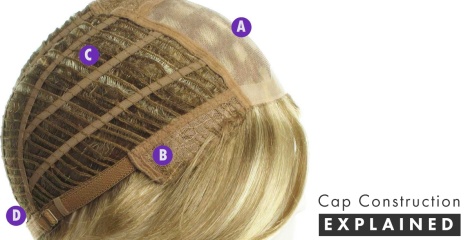
The area shown in the image below is known as the Internal Construction and this part of the wig can be made in only two ways.

When we talk about Internal Construction we are referring to the inside of the cap construction and the materials, that surround the main part of the head – from ear to ear and from the nape to the crown. In this area two main industry standards are available:
1. Hand-Tied.
Each hair on the entire wig cap is hand-tied onto the base, creating a smoother surface. This is ideal for a sensitive scalp and total hair loss. This is the softest and most comfortable cap, it’s ideal for a sensitive scalp & hair loss.

OR
2. Wefted.
A wefted wig wig incorporates a seam that holds a base of hairs (wefts) together on the cap, with the top of the construction usually left as an open cap. A weft is an individual strand of hair, which is either a synthetic hair fibre, or human hair fibre that has been stitched/sewn onto a material to create a row of hair strands. This construction is cost effective and creates some of the most popular styles.

B. The Top Construction
Definition:
The area shown in the image below is known as the Top Construction and this part of the wig can be made in five ways.

When we talk about the Top Construction we are referring to the inside of the cap construction and the materials, that surround the top of the head – from ear to ear and from the crown to the hairline.
In this area there five types of construction that are available, and these can be combined by the manufacturer to produce a wig that is suitable for any type of hair loss or occasion.
WEFTED
A wefted feature incorporates a seam that holds a base of hairs (wefts) together on the cap. This area can be sometimes covered by another material.


wefting
Monofilament (Single)
A monofilament feature means the complete area on top of the wig has had each hair ‘hand-tied’ to a soft lace material by hand.


Part-Monofilament
This part-monofilament feature is small area (usually the crown or parting area) that has been constructed in the same way as a monofilament (single).


Double Monofilament
The complete area on top of the wig that is constructed as a monofilament feature, but has an extra layer netting to cover the hand-tied knotting.


Lace Front
The lace front feature that is found on the front of the wig. It is a fine net that has been hand-knotted and will provide the illusion of a natural hair line.


lace front
Examples of combined construction types.
Why do manufacturers offer combinations? So you can benefit from the latest technology to help create the perfect styling options and to create the style of choice. The choices in construction can help with the cost and the comfort of the wig.

Internal construction: Wefted
Top construction: Wefted with inclusion of a lace front.
Benefits: Cheaper than hand-tied and still possible to wear away from the face.
Internal construction: Wefted
Top construction: Wefted with inclusion of a monofilament top and a lace front.
Benefits: Cheaper than hand-tied, still possible to wear away from the face and able to part anywhere on the top of the piece.


Internal construction: Wefted
Top construction: Wefted with inclusion of a part-monofilament top and a lace front.
Benefits: Cheaper than hand-tied, still possible to wear away from the face and able to part in one area.
Internal construction: Wefted
Top construction: Double monofilament top with a lace front.
Benefits: Cheaper than hand-tied, still possible to wear away from the face and extra comfort on scalp top.











Comments
No comments yet. Be the first!
Leave a Comment