

Does Heat Protectant Spray Work on Wigs? Human Hair, Heat-Friendly and Synthetic Explained


What's In This Article
Heat styling is the quickest way to make a wig your own: a wave through the ends, a sleeker fringe, a bit of lift at the crown. It’s also the quickest way to ruin one, and “do I need heat protector spray?” is one of the questions we’re asked most.
So, does heat protection spray work on wigs? Yes, no and sort of, depending on what your wig is made of. It works well on human hair, which is why we recommend it every time. It does something, but not what you’d think, on heat-friendly synthetic fibre, where the real protection is the temperature dial. And on a standard synthetic wig it does nothing at all, because no spray makes a standard synthetic safe to put heat on. This guide explains what a heat protectant actually does, what to use on each fibre, how to apply it to a wig properly, which tools to use, and what happens if you get it wrong. We’ve been styling wigs in our shop since 2007, and we’ve seen the full range of what happens when you don’t.
The Short Answer
Does heat protectant spray work? On human hair wigs, yes: it reduces moisture loss and surface damage every time you style with heat, and we’d never style one without it. On heat-friendly synthetic wigs, partly: a heat protectant made for synthetic fibre adds slip and reduces static and friction, but the thing that keeps the fibre safe is staying at around 130°C. On standard synthetic wigs, not at all: heat melts the fibre and no spray changes that. If you don’t know which you have, the label will say; if it doesn’t say heat-friendly, heat-resistant or heat-defiant, assume it isn’t.
What a Heat Protectant Actually Does
A heat protectant is a light film, usually of silicones or film-forming polymers, that sits on the surface of the hair. It does three things. It slows the rate at which heat travels into the strand, so a 150°C iron isn’t a 150°C shock. It spreads the heat along the surface rather than letting it concentrate in hot spots. And it slows moisture loss, which is what leaves heat-styled hair dry and brittle. It doesn’t make hair heat-proof, and no amount of spray makes up for a tool that’s too hot. Think of it as a buffer, not a shield.
That explanation is also why the answer changes by fibre. Human hair has a cuticle and moisture to protect. Synthetic fibre is plastic; it has neither, and when it gets too hot it doesn’t dry out, it deforms.
First, the One That Can't Be Fixed: Standard Synthetic Wigs
Can you use heat protectant on synthetic wigs to make them safe for straighteners? No. Standard synthetic fibre is heat-set into its style at the factory and will not take heat again. Above roughly 60°C it softens, and the result is fibre that’s frizzed, matted at the ends, flattened where the plates touched, or melted together. It’s permanent and it’s the single most common way we see wigs destroyed. A heat protectant does nothing to change the fibre’s melting point, so there’s no point using one; the only protection is not using heat.
So can you straighten a synthetic wig, or curl it? Not with heat. You can change the texture with styling products made for synthetic fibre, set waves with a heatless curl method, or settle the fibre with steam, which is gentler than a tool but still worth a word with us first. If you want to heat style regularly, the answer is a heat-friendly wig, and the difference in price is small.
Everything below is about human hair and heat-friendly wigs.
Heat Protection Spray for Human Hair Wigs: Where It Works
A human hair wig behaves like your own hair under heat, with one difference that matters: it has no scalp. Your own hair is continuously conditioned by natural oils; a wig’s hair has nothing but what you put on it, and most human hair wigs have been processed before you bought them, which makes them more fragile than hair on a head. That’s why a heat protectant spray for a human hair wig isn’t optional in our view. It reduces moisture loss, prevents the dryness that creeps in after a few weeks of styling, and keeps the shine.
Temperature: around 150°C is the ceiling we’d suggest for a human hair wig, and lower if the hair is fine or has been coloured. Check the manufacturer’s guidance for your wig; some say less. Hold the tool moving, never resting, and don’t go over the same section twice. If you’re choosing between a human hair wig and a heat-friendly one partly for the styling freedom, our guide to whether human hair wigs are worth the extra cost weighs it up, and our human hair wigs collection shows the range.
Can you use the heat protectant you use on your own hair? Yes, if it’s a light spray, alcohol-free, and not oil-based. Heavy serums and oils build up on a wig because there’s no scalp and no daily wash to shift them, and build-up is what makes a human hair wig look dull and feel heavy. Light, mist, comb through, done.
Heat-Friendly Wigs: The Spray Helps, the Temperature Protects
Heat-friendly (also called heat-resistant or heat-defiant) fibre is a synthetic made to tolerate styling tools, typically up to around 130°C and sometimes a little more depending on the brand; the heat resistant wig temperature on the label is the one to follow. It’s still plastic, so it absorbs nothing, which means a heat protectant doesn’t work on it the way it works on human hair. There’s no moisture to keep in and no cuticle to seal.
What a protectant made for synthetic fibre does do is useful: it adds slip, so the plates glide instead of dragging; it reduces the static that heat-friendly fibre is prone to; and it helps the ends, which take the most heat, stay soft rather than going dry and wiry. We’d use one. But we’d be honest that it’s a comfort, not a safeguard. The safeguard is the temperature. A heat-friendly wig styled at 120°C with no spray will outlast one styled at 180°C with half a bottle. Set the dial low, keep the tool moving, and the spray does the rest.
One honest note on anti-static spray. It’s a lovely product for heat-friendly fibre and we recommend it for everyday wear, but it isn’t a heat protectant and we don’t want to pretend it is. Use it to tame static and add shine; use a protectant formulated for synthetic fibre before heat. Our guide to heat-friendly wigs covers how to curl, straighten and refresh them step by step.
Which Fibre Is Which: A Comparison Table
| HUMAN HAIR | HEAT-FRIENDLY SYNTHETIC | STANDARD SYNTHETIC | |
|---|---|---|---|
| Can you use heat? | Yes | Yes, within the label’s limit | No, never |
| Maximum temperature | Around 150°C; check the label; lower for fine or coloured hair | Around 130°C; check the label | None |
| Does heat protectant work? | Yes: reduces moisture loss and surface damage | Partly: adds slip, reduces static and friction; the temperature does the protecting | No: nothing makes it heat-safe |
| Which product | A light, alcohol-free heat protection spray | A heat protectant made for synthetic fibre; anti-static spray for everyday static, not heat | Styling products for synthetic fibre; heatless methods |
| If you get it wrong | Dry, brittle, dull hair that can be conditioned back to some extent | Frizz and loss of style at the ends; permanent if the limit is exceeded | Melted, matted or frizzed fibre; permanent |
| How to tell | Label and price; feels and smells like hair when warm | Label says heat-friendly, heat-resistant or heat-defiant | Label doesn’t say any of those |
How to Apply Heat Protectant to a Wig
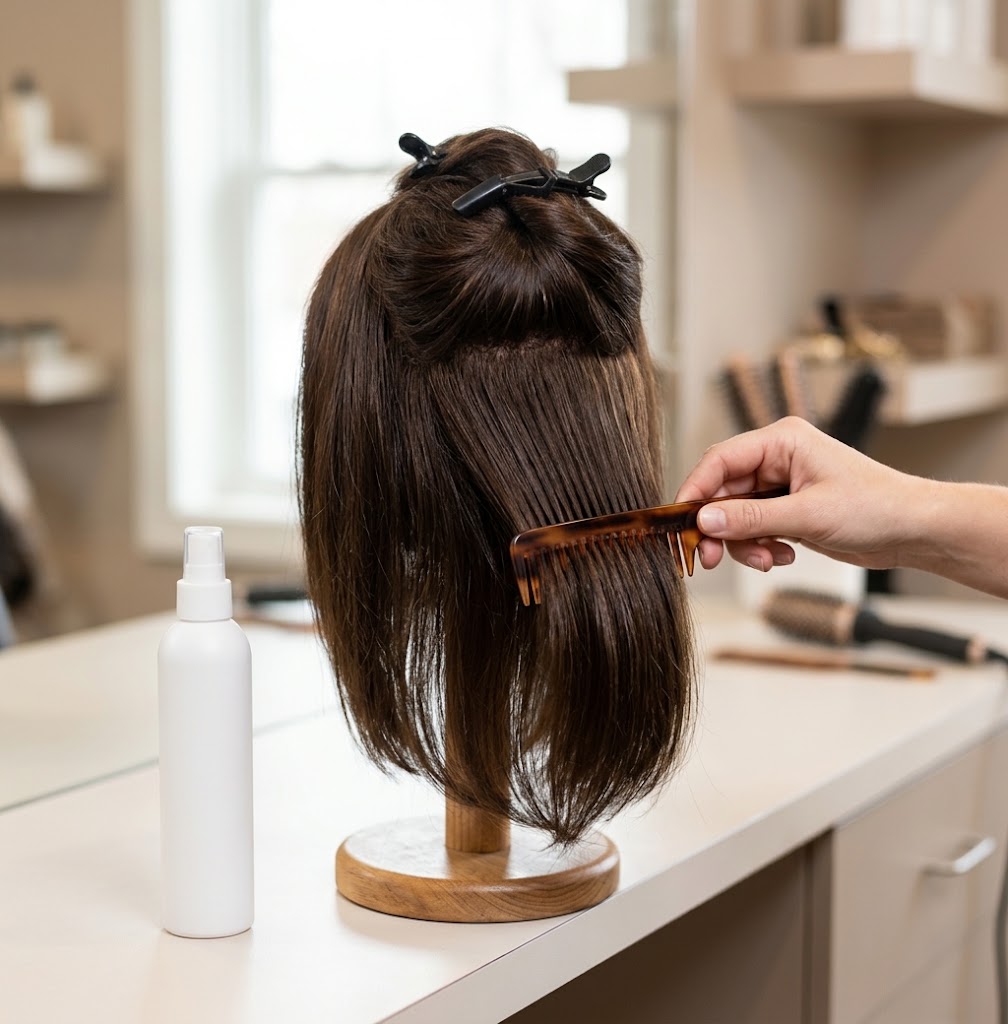
How to use heat protectant spray on your own hair and how to use it on a wig are nearly the same job, with one rule that matters more: the wig must be completely dry before heat touches it. Here’s how we do it in the shop.
- Put the wig on a stand. You need to see and reach every section, and you need the fibre to hang the way it will on you. A wig stand costs a few pounds and makes everything easier.
- Brush it through with a wig brush, ends first, so the spray reaches every strand rather than the outside of a tangle.
- Section it. Clip the top up and work from the underneath, in sections a few centimetres wide. You’ll use less product and miss nothing.
- Mist, don’t soak. Hold the bottle about 20cm away and give each section one or two light passes. Heat protectant on dry hair is the right call for a wig; a damp wig under a hot tool steams, and steam is heat.
- Comb it through. A wide-tooth comb spreads the film evenly. An uneven coat leaves unprotected patches, which is where damage starts.
- Let it dry completely. This is the step people skip. Give it five minutes until the fibre feels dry to the touch. If it still feels damp or tacky, wait.
- Then style, at the right temperature for the fibre, tool moving, one pass per section.
- Reapply only when you wash. A human hair wig needs fresh protectant each time you heat style after washing; between washes, a light mist on the ends is enough. On heat-friendly fibre, once per styling session.
Which Straighteners and Tongs to Use
The tool matters more than the spray, and most straighteners in the house are wrong for a wig. The popular fixed-temperature models run at about 185°C, which is too hot for human hair wigs and will destroy heat-friendly fibre on contact. What you want is a tool with a dial that goes down to 120°C or below. We recommend Cloud Nine, whose irons go as low as 100°C; they’re not cheap, but they’re the ones we use. Any tool with a genuine low setting will do; check that the lowest number on the dial is a number you can actually use. Set it to the fibre’s limit or below, let it reach temperature, and test on a hidden section at the nape before you touch the front.
The Products We Recommend
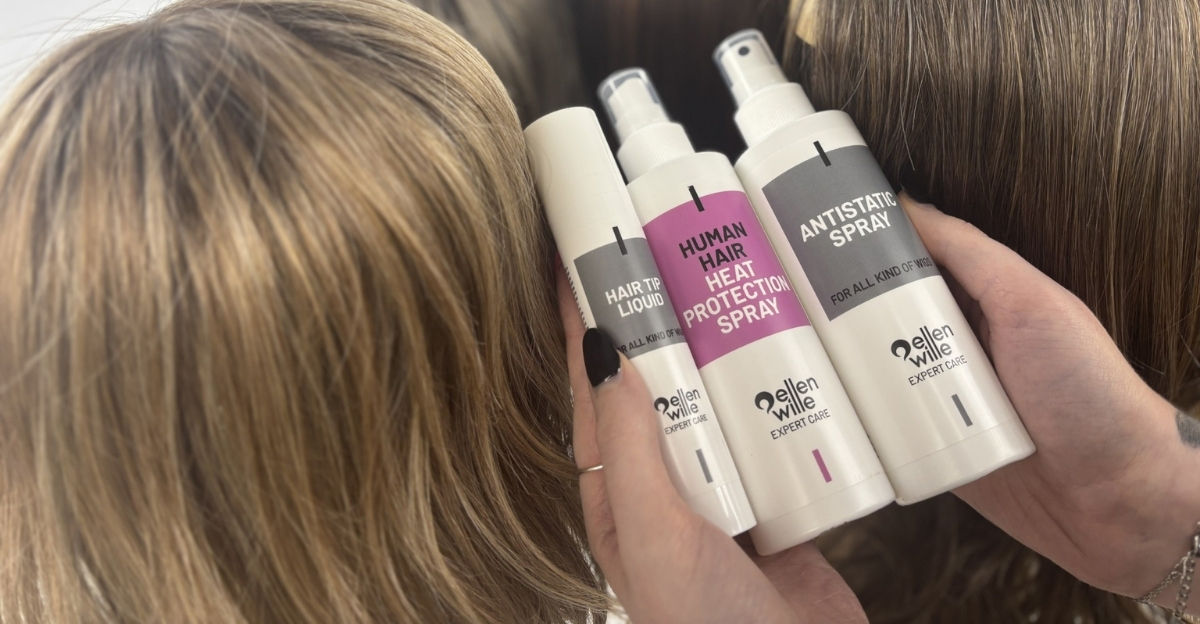
- For human hair wigs: Ellen Wille Heat Protectant Spray, a light mist designed for wigs, before every heat styling session. Styling Spray Gel if you want hold afterwards.
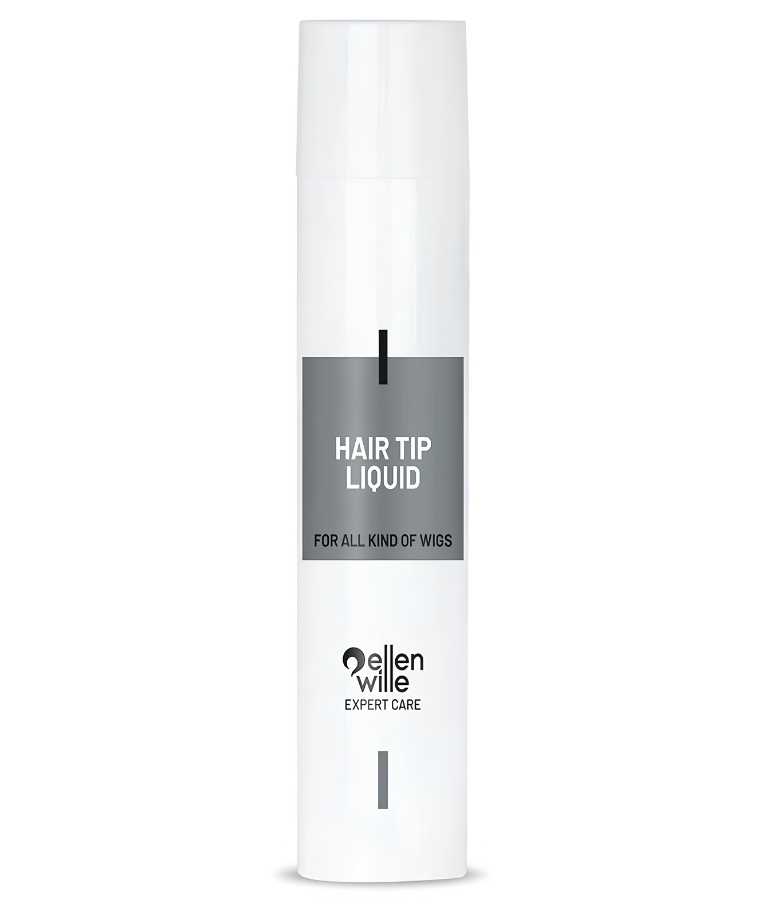
- For heat-friendly wigs: the same Ellen Wille Protectant Spray, which is formulated for heat-friendly fibre as well as human hair confirm with manufacturer guidance before using heat. Ellen Wille Anti-Static Spray for everyday static and shine, and a little Ellen Wille Hair Tip Liquid on the ends if they’re feeling dry.
- For standard synthetic wigs: no heat products, because no heat. Our guide to styling products for synthetic wigs covers texture, hold and shine without a tool in sight, and removing the shine is the other question we’re asked every week.
If you’re not sure what fibre you have or which product to use, get in touch with the wig’s name and we’ll tell you. Or book a free appointment in Slaithwaite and we’ll style it with you.


Heat Protectant FAQs
These are the heat protectant questions we’re asked most, from which spray to use to the right temperature for your fibre, with the short answers. If yours isn’t here, just ask and we’ll happily help.
- Does heat protectant spray work on wigs?
-
On human hair wigs, yes; it reduces moisture loss and surface damage and we recommend it every time. On heat-friendly synthetic wigs it adds slip and reduces static, but the real protection is keeping the tool at or under the label’s temperature. On standard synthetic wigs it does nothing, because no spray makes them heat-safe.
- Can you use heat protectant on a synthetic wig?
-
On a heat-friendly synthetic, yes, with a protectant made for synthetic fibre. On a standard synthetic, there’s no point: heat will melt the fibre whether or not it’s sprayed, so don’t use heat at all.
- What temperature should I use on a wig?
-
Around 150°C for human hair wigs and around 130°C for heat-friendly synthetic, or lower if the manufacturer’s label says so. Fixed-temperature straighteners at 185°C are too hot for any wig.
- Can I use my normal heat protectant on a human hair wig?
-
Yes, if it’s a light, alcohol-free spray. Avoid oils and heavy serums; without a scalp and a daily wash they build up and dull the hair.
- Should heat protectant go on a wet or dry wig?
-
Dry. Mist it on, comb it through and let it dry completely before any heat. A damp wig under a hot tool steams, and steam damages fibre.
- Is anti-static spray a heat protectant?
-
No. It reduces static and adds shine on synthetic fibre, and it’s good for that. Before heat on a heat-friendly wig, use a protectant made for synthetic fibre and keep the temperature low.
- Can heat protectant stop a wig being damaged completely?
-
No. It reduces damage; it doesn’t prevent it. Going over the recommended temperature damages fibre permanently, spray or no spray. Lower heat, one pass, tool moving.
- Can you straighten or curl a synthetic wig?
-
Not with heat unless it’s heat-friendly. Standard synthetic can be textured with styling products or heatless methods. Heat-friendly fibre can be straightened or curled at or under 130°C; our heat-friendly wigs guide shows how.











Comments
No comments yet. Be the first!
Leave a Comment