

Can a Vegan or Vegetarian Diet Cause Hair Loss? What to Check and How to Fix It


What's In This Article
If you’ve gone vegan or vegetarian, or simply cut down on meat, and a few months later you’ve noticed more hair in the plughole, you’re not imagining the connection and you’re not alone in asking about it. We hear this question over the phone or in our shop every month, and the honest answer is: a plant-based diet doesn’t cause hair loss, but an unplanned one can.
We’ve been helping people with hair loss since 2007, and diet is one of the causes that’s most often fixable. This guide explains why cutting out meat can affect your hair, which nutrients are usually behind it, what the hair loss looks like and how long it lasts, which blood tests to ask your GP for, and how to put it right with food first and supplements where they’re needed. It’s written for vegans, vegetarians and anyone in between.
The Short Answer
Can not eating meat cause hair loss? It can, if it leaves you short of iron, vitamin B12, zinc or protein, or if the change came with rapid weight loss. The hair loss this causes is usually a diffuse thinning all over rather than bald patches, it tends to appear two to three months after the change, and it almost always recovers once the shortfall is corrected. A well-planned vegan or vegetarian diet gives your hair everything it needs. The fix is planning, and in some cases a supplement, not going back to meat.
Why Cutting Out Meat Can Affect Your Hair
Hair is a low priority for your body. When a nutrient runs short, your body sends what it has to your heart, blood and brain first and to your hair last. That’s why a mild deficiency that causes no other symptoms can still show up as shedding.
Meat, fish, eggs and dairy happen to be concentrated sources of several nutrients hair depends on: iron in its most easily absorbed form, vitamin B12, zinc, complete protein, iodine and vitamin D. None of these is impossible to get from plants, and vegetarians who eat eggs and dairy keep several of them. But the plant forms of some (iron and zinc in particular) are absorbed less well, one (B12) isn’t reliably found in plants at all, and it’s easy to change your diet without changing the planning around it. The gap opens quietly, and hair is often the first thing to notice.
Two things make it more likely: switching suddenly rather than gradually, and losing weight quickly at the same time. Both are common in the first months of going vegan, which is why people so often connect the two.
What Diet-Related Hair Loss Looks Like, and When It Stops
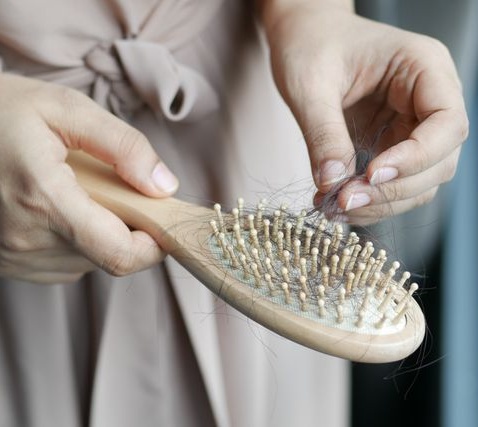
Hair loss from a nutritional shortfall is nearly always a condition called telogen effluvium. It’s worth knowing the name, because it tells you what to expect.
- It’s diffuse. Thinning all over the scalp, often most noticeable at the parting and temples, with more hair than usual coming out when you wash or brush. It is not round bald patches; if you have those, see the section on when it isn’t your diet.
- It’s delayed. Hair follicles that are pushed into their resting phase by a trigger take two to three months to shed. So hair loss that starts in June usually points to something that changed in March or April.
- It’s reversible. Once the trigger is corrected, shedding typically settles within three to six months and the hair regrows over the following year. The follicles aren’t damaged; they’re waiting.
Normal shedding is around 50 to 100 hairs a day, according to the NHS. If you think you’re losing more, our guide to whether your hair loss rate is normal has a simple way to check, and The Comprehensive Hair Loss Guide covers the other causes.
The Nutrients That Matter Most on a Plant-Based Diet
These are the ones we’d check first, in roughly the order they cause trouble. Reference intakes are the NHS figures for adults; your GP or a dietitian may advise you differently.
| NUTRIENT | WHY HAIR NEEDS IT | WHY PLANT-BASED EATERS CAN RUN SHORT | BEST PLANT SOURCES |
| Iron | Carries oxygen to the follicle; low ferritin (stored iron) is one of the most common findings in women with diffuse hair loss | Plant (non-haem) iron is absorbed less efficiently than iron from meat; tea and coffee with meals reduce it further | Lentils, chickpeas, beans, tofu, pumpkin seeds, dried apricots, fortified cereals, dark leafy greens; eat with vitamin C |
| Vitamin B12 | Needed to make red blood cells and for cell division in the follicle; deficiency causes diffuse loss, tiredness and sometimes tingling | Not reliably present in any plant food; vegans need fortified foods or a supplement, and long-term vegetarians can run low too | Fortified plant milks, cereals and nutritional yeast; a supplement |
| Zinc | Supports follicle repair and the oil glands that protect hair; deficiency causes shedding and dull, brittle hair | Plant zinc is bound up by phytates in grains and beans, so less is absorbed | Pumpkin and hemp seeds, chickpeas, lentils, tofu, cashews, wholegrains; soaking and sprouting help |
| Protein | Hair is made of keratin, a protein; too little and the body stops making it | Easy to under-eat when meat is removed without replacing it, especially the amino acid lysine | Tofu, tempeh, edamame, lentils, beans, seitan, quinoa, nuts and seeds; a variety across the day covers all amino acids |
| Vitamin D | Follicles have vitamin D receptors; low levels are linked with several types of hair loss | Not a vegan problem specifically: the NHS advises everyone in the UK to consider a supplement from October to March | Sunlight, fortified spreads and plant milks, mushrooms exposed to UV; a supplement in winter |
| Iodine | Needed by the thyroid, and an underactive thyroid is a common cause of hair loss | Main UK sources are dairy and fish; vegans are a recognised at-risk group | Iodised salt where available, fortified plant milks, seaweed in moderation (some are very high); a supplement if advised |
| Omega-3 | Supports scalp health; evidence for hair itself is limited | Plant omega-3 (ALA) converts poorly to the forms found in fish | Flaxseed, chia, walnuts, rapeseed oil; an algae-based supplement if wanted |
| Selenium | Antioxidant; both too little and too much can cause hair loss | Rarely short in the UK, but worth knowing that Brazil nuts are very high | One or two Brazil nuts a day is plenty; don’t take a high-dose supplement without advice |
A Closer Look at Iron
Iron is the one we’d look at first, particularly for women. Plant iron is absorbed at roughly a third to a half the rate of iron from meat, and the NHS recommends 14.8mg a day for women aged 19 to 49, which is a lot of lentils. The good news is that absorption can be improved a great deal: eat iron-rich foods with a source of vitamin C (peppers, tomatoes, citrus, broccoli), keep tea and coffee to an hour either side of meals rather than with them, and cook in a cast-iron pan if you have one. Many trichologists like to see ferritin, the measure of stored iron, comfortably above the bottom of the normal range before they’ll rule iron out as a cause of shedding, so ask for the number, not just “normal”.
A Closer Look at Vitamin B12
B12 deficiency hair loss is the one most specific to a vegan diet, because B12 is made by bacteria and is found reliably only in animal foods. There is no plant food you can eat enough of. The NHS is clear that vegans need fortified foods or a supplement, and because the body stores B12 for years, a deficiency can take a long time to show and a long time to reverse. Symptoms alongside hair loss include tiredness, a sore or red tongue, pins and needles and low mood. Vegetarians who eat eggs and dairy usually get enough, but long-term vegetarians and older adults can still run low. A simple blood test tells you where you are.
Which Blood Tests to Ask Your GP For
“See your GP” is easy advice to give and hard to act on if you don’t know what to ask. If you’ve been plant-based for a while and your hair is thinning, these are the tests that usually get to the bottom of it. Your GP will decide which are appropriate.
- Full blood count, to check for anaemia
- Ferritin, for stored iron; ask for the actual figure
- Vitamin B12 and folate
- Vitamin D
- Thyroid function (TSH), because thyroid problems are a common cause of hair loss and easy to miss
- Zinc, if your GP thinks it’s worth checking; it isn’t always routine
Take a note of when the hair loss started and when your diet or weight changed. The two-to-three-month gap is a useful clue for your GP. Alopecia UK has a helpful guide to preparing for a GP appointment about hair loss.
A Food-First Plan for Vegan and Vegetarian Hair Growth
Supplements have their place (see below), but the best vegan foods for hair growth are the ones you’ll eat every day. Here’s how our customers who’ve been through this usually put it together.
- Build every meal around a protein. Tofu, tempeh, lentils, beans, edamame or seitan, in a decent portion, at every meal rather than once a day.
- Pair iron with vitamin C. Lentil dahl with tomatoes; a bean chilli with peppers; hummus with red pepper sticks; fortified cereal with berries.
- Add seeds. A tablespoon of pumpkin or hemp seeds on almost anything covers a surprising share of your zinc.
- Go fortified. Choose plant milks and cereals fortified with B12, iodine, calcium and vitamin D. Check the label; not all are.
- Move the tea. Have tea and coffee between meals, not with them.
- Don’t crash. If you’re losing weight, aim for slow and steady, and don’t let meals get so small that hair pays for it.
Vegetarians who eat eggs and dairy have an easier job on B12, iodine and complete protein, but the iron and zinc advice applies just as much. The Vegan Society and the British Dietetic Association both publish clear, practical guidance on planning a plant-based diet.
Do You Need Supplements?
Some. Vegan hair vitamins marketed for hair specifically are mostly expensive ways to buy the same few nutrients, and megadoses of some (selenium, vitamin A, even zinc) can cause hair loss rather than cure it. What the NHS actually recommends is simpler.
- B12: every vegan should take one, or eat fortified foods every day. Non-negotiable.
- Vitamin D: everyone in the UK should consider 10 micrograms a day from October to March.
- Iodine: worth discussing with your GP or a dietitian if you’re vegan and don’t use fortified milk.
- Iron: only if a blood test shows you’re low. Iron supplements taken without need can cause problems of their own.
- Everything else: food first, unless a test says otherwise.
If a supplement is right for you, it takes time to work. Expect three to six months before shedding settles, and longer before regrowth is obvious. That’s not the supplement failing; it’s the hair cycle.
When It Isn't Your Diet
Diet is one cause among many, and it’s easy to blame the most recent change. It probably isn’t your diet if:
- The hair loss is in round or oval patches rather than all over. That pattern is usually alopecia areata, an autoimmune condition, and it needs a GP or dermatologist rather than a change of menu. A reader called Thomas described exactly this in the comments below; Thomas, if you’re still reading, please see your GP.
- It’s gradual thinning at the crown and parting over years, which is more likely to be female or male pattern hair loss, often with a family history.
- Something else changed at the same time: stress, illness, a new medication, pregnancy or the months after it, or a hormonal shift.
- Your blood tests are all normal and your diet is well planned. Then the cause is elsewhere, and your GP can help you find it.
Whatever the cause, if thinning is affecting how you feel about yourself, you don’t have to wait for regrowth to feel like you. Our guide to coping with hair loss and rebuilding your confidence is a good place to start, and hair toppers are designed for exactly the kind of diffuse thinning this article describes; our guide to wigs and hairpieces for thinning hair explains the options. Or book a free appointment and we’ll show you.
Frequently Asked Questions
Got questions about vegan or vegetarian diets and hair loss? Here are some of the most common things people ask us.
- Can a vegan diet cause hair loss?
-
Not by itself. An unplanned vegan diet can leave you short of iron, vitamin B12, zinc or protein, and any of those can cause diffuse hair loss. A well-planned vegan diet with a B12 supplement gives your hair what it needs.
- Can not eating meat cause hair loss?
-
Cutting out meat without replacing the iron, zinc and protein it provided can, especially if you also lose weight quickly. The fix is replacing those nutrients from plant sources, not necessarily eating meat again.
- Does a vegetarian diet cause hair loss?
-
Vegetarians who eat eggs and dairy are at lower risk than vegans for B12 and iodine, but can still run low on iron and zinc. The same checks apply.
- How long after going vegan does hair loss start?
-
Usually two to three months after the change, because follicles that enter their resting phase take that long to shed. Hair loss that starts sooner is more likely to have another cause.
- Will my hair grow back if I fix my diet?
-
In most cases, yes. Diet-related hair loss is telogen effluvium, which recovers once the trigger is corrected. Shedding typically settles within three to six months and regrowth follows over the next year.
- What deficiency causes hair loss in vegans?
-
Iron (low ferritin), vitamin B12, zinc and protein are the usual suspects. Vitamin D, iodine and, rarely, selenium can also play a part. A blood test tells you which, if any, applies to you.
- Should vegans take hair vitamins?
-
Take a B12 supplement, consider vitamin D in winter, and discuss iodine with your GP or a dietitian. Only take iron or zinc if a test shows you’re low. Multi-ingredient hair vitamins are rarely necessary and high doses of some nutrients can make hair loss worse.
- Is hair loss on a plant-based diet permanent?
-
Very rarely. Nutritional hair loss doesn’t damage the follicle. If hair doesn’t recover within a year of correcting your diet, another cause is likely and worth investigating with your GP.





Comments
No comments yet. Be the first!
Leave a Comment